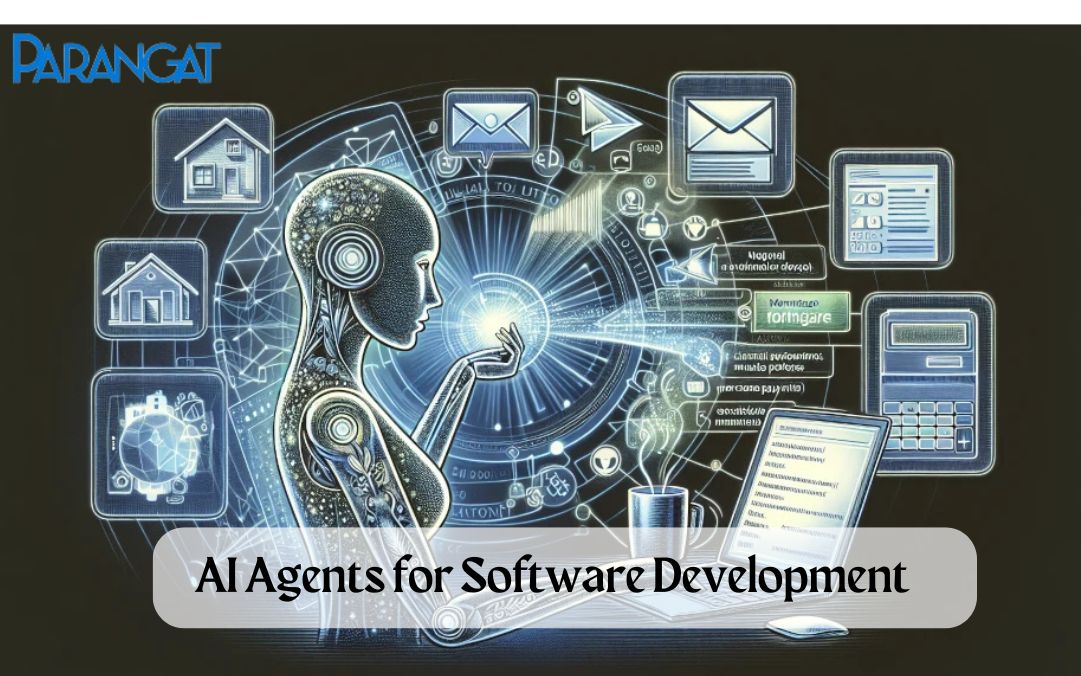
AI Agents in Software Development: The Future of Productivity, Speed & Innovation
13/Oct/2025


Software development is entering a new era. After years of depending on manual coding, traditional automation, and human-driven workflows, engineering teams are now unlocking unprecedented levels of speed and efficiency—thanks to AI agents.
These intelligent, autonomous systems don't just generate code. They plan, reason, test, review, deploy, and even optimize workflows. For startups, enterprises, and product teams looking to scale faster at lower cost, AI agents are becoming a strategic advantage rather than a futuristic idea.
Below, we break down what AI agents really mean for software teams, what the most impactful use cases look like, and how businesses can adopt them safely and at scale.
Why Software Teams Are Turning to AI Agents
Modern development teams are under pressure:
- Shorter release cycles
- Rapid market expectations
- Increasingly complex architectures
- Smaller engineering bandwidth
- High costs of quality assurance
Even with strong teams, productivity plateaus. A large portion of engineering hours still goes into:
- Repetitive coding
- Writing unit tests
- Fixing regressions
- Manual code reviews
- Deploying builds
- Maintaining documentation
AI agents are designed to eliminate these friction points.
What changes when teams adopt AI agents?
- Features ship faster
- Manual tasks shrink
- Bugs surface earlier
- Releases become more predictable
- Developers focus on design, logic, and innovation
What Are AI Agents and How Do They Work in Real Dev Lifecycles?
AI agents are autonomous systems that can understand tasks, break them into smaller steps, execute them, evaluate their own output, and refine the results—without continuous human intervention.
They work across the development lifecycle by:
- Analyzing product requirements
- Generating code based on context
- Running tests automatically
- Identifying and fixing issues
- Triggering builds and deployments
- Maintaining documentation
- Integrating with GitHub, Jira, CI/CD, and APIs
Key Capabilities of AI Agents
1. Code Generation with Context
AI agents develop features aligned with architecture, business logic, and coding standards.
2. Autonomous Debugging
They detect anomalies, identify root causes, and suggest or implement fixes.
3. Test Automation
From writing unit tests to running regression suites, testing becomes dramatically faster.
4. Code Review & Quality Assurance
Agents enforce quality, security, and style guidelines consistently—every time.
5. DevOps Orchestration
CI/CD pipelines can be monitored and triggered autonomously, improving reliability.
Practical Use Cases Transforming Software Development
AI agents are already being used across high-growth startups and enterprise engineering teams. Here are the impact-driven use cases delivering measurable results:
1. Faster Feature Development
Agents can write structured, clean code for backend APIs, UI components, microservices, and integrations cutting development time significantly.
2. End-to-End Test Automation
From unit tests to integration tests, agents automate test creation and execution, helping teams catch bugs earlier and reduce QA cycles.
3. Automated Code Reviews
Instead of waiting for developer bandwidth, agents perform instant reviews, highlight vulnerabilities, and ensure code consistency.
4. Continuous Deployment & Monitoring
AI systems can push builds, monitor performance, and even suggest optimization paths to engineering leads.
How AI Agents Boost Speed, Quality & Innovation
Organizations adopting AI agents are seeing compelling returns:
Higher Velocity
Teams deliver features faster by offloading repetitive and manual work.
Better Code Quality
Agents catch flaws earlier, reducing production bugs and rework.
Lower Engineering Costs
Automation reduces dependency on extra resourcing and overtime hours.
Faster Time-to-Market
Product teams respond to market needs and customer feedback faster than ever.
More Innovation
Developers reinvest saved time into architecture, performance, design, and R&D.
These improvements directly impact business growth—especially for companies scaling digital products or shifting to aggressive release cycles.
How Nohitatu Helps Teams Adopt AI Agents with Confidence
At Nohitatu, we help organizations implement AI agents the right way—securely, strategically, and with measurable impact.
Our AI development services include:
- Custom AI agent design for engineering workflows
- Integration with existing repositories, CI/CD pipelines, APIs, and tools
- Automated code generation, testing, and deployment workflows
- Enterprise-grade security and governance
- End-to-end implementation, from discovery to production rollout
Whether you're a startup building faster with limited resources or a growing tech team seeking higher throughput, our AI-led development approach accelerates every stage of your lifecycle.
Ready to Transform Your Engineering Workflow?
If you're looking to reduce engineering bottlenecks, accelerate launches, or innovate faster, AI agents can be your competitive edge.
Nohitatu helps you adopt them with confidence, clarity, and real business value.
Discover how AI agents can reshape your development productivity.
Book a Demo